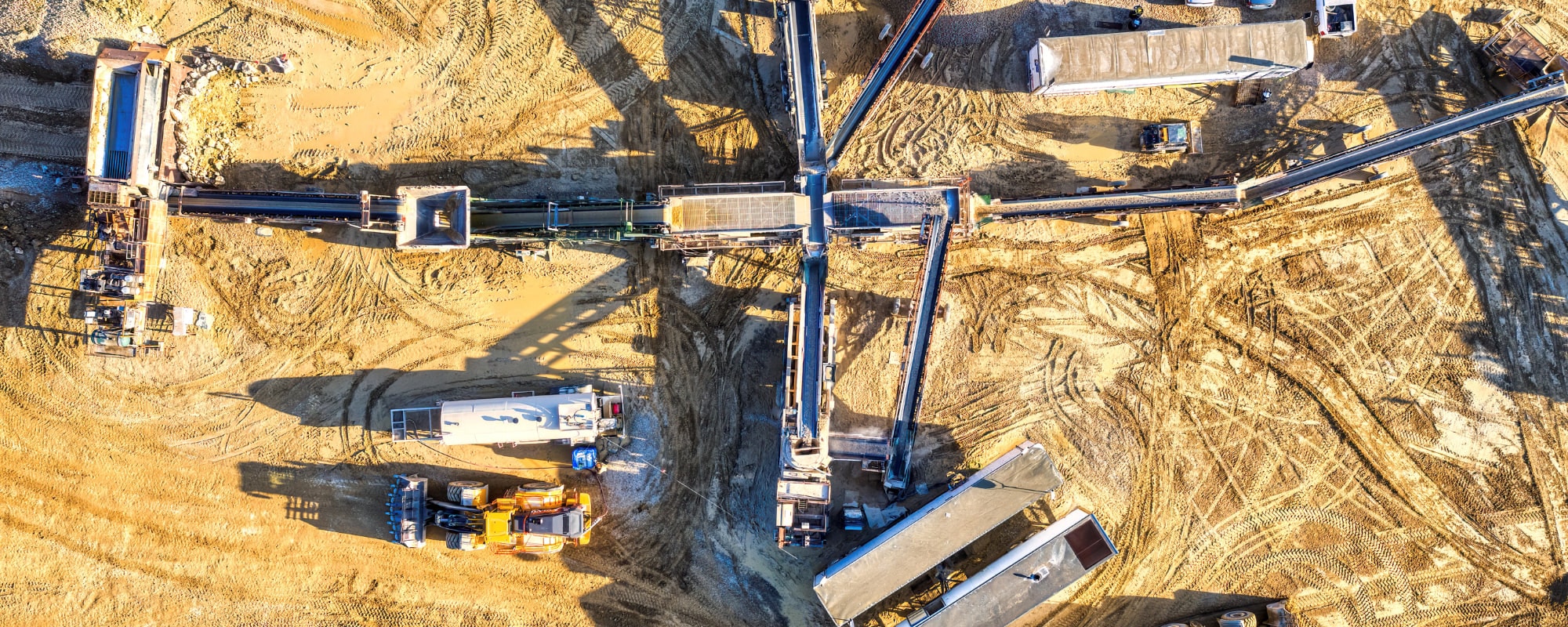
Real work is coming online across four states. The harder question is whether your business can mobilise for it without running short of cash.
In this article
In this update:
- Toowoomba–Warwick Pipeline, Stage 1 (Queensland)
- Palmer Wind Farm (South Australia)
- Mitchells Causeway new crossing, Victoria Pass (New South Wales)
- Macquarie Point stadium site-preparation works (Tasmania)
- SCOPE, GAP, BUFFER, STRUCTURE: A simple framework for growth
- Matching loan structure to how the work actually pays
- Operator checklist: before you mobilise for new work
- Frequently asked questions
Growth is real. So is the squeeze.
Look past the headlines and there is genuine project activity moving right now: a pipeline stage has been awarded in Queensland, a wind farm is under construction in South Australia, a highway crossing has been awarded in New South Wales, and a stadium site is being prepared in Hobart. For operators in civil, earthmoving, heavy-haul, piling and bulk-earthworks, that is a real signal to plan around.
Recent ABS data points to a mixed investment picture rather than a straight-line rise. In the June 2026 quarter, private new capital expenditure on equipment, plant and machinery fell 8.9 per cent on a seasonally adjusted basis, while remaining 18.7 per cent higher than a year earlier; the corresponding trend estimate rose 3.6 per cent. The ABS’s third estimate of total capital expenditure for 2026–27 was $200.7 billion, 15.5 per cent above the previous estimate. These are economy-wide figures across all industries—not a measure of transport, machinery or civil-sector spending specifically, and not evidence about any particular TMF operator—but they show continued investment intent alongside quarter-to-quarter volatility.
At the same time, cost pressure remains material. The ABS’s final Business Conditions and Sentiments release, based on responses collected from 4 to 15 June 2026, found 46 per cent of businesses reported higher operating expenses over the previous four weeks. Fuel prices were reported by 71 per cent of those businesses and business overheads by 65 per cent; 28 per cent of businesses expected meeting financial commitments over the next four weeks would be difficult or very difficult. In construction, the June 2026 quarter recorded wages and salaries up 1.4 per cent, company gross operating profits up 1.7 per cent and sales volumes up 0.5 per cent. Those construction figures show costs and activity moving together and should not be presented as evidence of a sector-wide margin squeeze. The RBA’s cash rate target remained at 4.35 per cent following the Board’s 11 August 2026 decision, effective 12 August 2026.
None of that means growth is a bad idea. It means the finance decision behind the gear now matters as much as the machine itself.
In this update
- Four current project signals — Queensland, South Australia, New South Wales and Tasmania — and what each means for operators, not just headline news
- A simple framework for the cashflow side of growth: SCOPE, GAP, BUFFER, STRUCTURE
- A short primer on matching loan structure and serviceability to how your business actually earns
- An operator checklist to run before mobilising for new work
None of the four projects below are guaranteed work for any particular operator, and none of the named machines mentioned are confirmed on these projects. They are illustrative examples only, used to make the finance and capability decisions concrete.
Toowoomba–Warwick Pipeline, Stage 1 (Queensland)
Seqwater has awarded the Stage 1 construction contract for the Toowoomba to Warwick Pipeline to CPB Contractors and Nacap, delivering as a joint venture. The project remains pre-construction, with works expected to commence in late 2026 — this is an awarded stage, not a project under construction yet. Stage 1 covers a 47-kilometre pipeline from the Perseverance connection at Highfields to the Greenmount offtake, with reservoirs, pump stations, offtakes and network integration. Current procurement packages span earthworks, piling, trenchless crossings, vacuum excavation, and plant, crane, truck and float hire. More than $300 million is confirmed for the whole, approximately 111-kilometre project — that figure covers the full pipeline, not the Stage 1 contract alone, and Stage 2 from Greenmount to Warwick remains subject to a future government decision.
For operators, an award like this is real, but it is a scope award for one stage — not a guarantee of the work that follows it.
TMF Lens: Win More Work. Finance the awarded stage and the mobilisation gap in front of you; don't assume Stage 2 or follow-on packages before they exist.
Palmer Wind Farm (South Australia)
Tilt Renewables confirms Palmer Wind Farm is under construction, with formal on-site works commencing in July 2026. Vestas is supplying and installing turbines, BMD is delivering civil and electrical balance-of-plant works including road upgrades, and ElectraNet is handling the grid connection. Current early works include site facilities, two permanent access points off Randell Road, internal roads, clearing and rock removal. The project comprises 40 turbines, up to 288 MW of capacity and blade-tip heights of up to 220 metres. Oversize and overmass turbine-part deliveries are scheduled to commence in 2027.
The heavy-haul opportunity here is not just the prime mover. It is the whole package: trailer configuration, permits, escorts, fuel, crew and the timing between doing the job and being paid for it.
TMF Lens: Protect Uptime. Model the complete haulage package and the delay buffer, not the truck alone.
Mitchells Causeway new crossing, Victoria Pass (New South Wales)
The NSW Government awarded Seymour Whyte the contract to deliver a new crossing at Mitchells Causeway, Victoria Pass, on 26 June 2026, following accelerated procurement. This is a standalone crossing project — not a package within the wider, paused Great Western Highway upgrade program. The new bridge structure will sit over the existing causeway on deep piles anchored into stable bedrock, with specialist drilling, grouting and heavy piling. The road was expected to reopen in the second quarter of 2027 at the time of the award; no official total project value has been released.
Specialist piling and drilling capability is clearly needed for this job. The commercial question for any operator looking at that capability is what happens after this one job finishes.
TMF Lens: Upgrade Strategically. Run the second-job test for specialist piling and drilling capability before you commit to it.
Macquarie Point stadium site-preparation works (Tasmania)
Preparatory works for the Macquarie Point multipurpose stadium are underway in Hobart, with Hazell Bros undertaking bulk earthworks following a competitive procurement process. The current package covers approximately 100,000 cubic metres of bulk excavation, site preparation and archaeological investigations, running through to mid-2027. This site-preparation package is separate from the main stadium construction contract, which remains in its own procurement process, with contractor appointment expected toward the end of 2026. The project remains a politically and publicly discussed site in Hobart; this update sticks to the confirmed, current site-preparation works.
TMF Lens: Grow Without Overstretching. Add excavation capacity only against a proven, confirmed workfront — and only where the rest of the fleet can support it.
SCOPE, GAP, BUFFER, STRUCTURE: A simple framework for growth
Four different projects, four different pathways — but the same underlying finance question sits behind all of them.
- SCOPE — What has actually been awarded or confirmed, versus what is assumed or hoped-for follow-on work. Toowoomba's Stage 1 award and its not-yet-decided Stage 2 is the clearest example of this distinction in this update.
- GAP — The mobilisation-to-payment gap. Crew, fuel, permits, transport and, depending on the job, machinery costs may need to be paid before the first progress payment clears.
- BUFFER — The working capital held in reserve to cover that gap, plus a margin for delay or a smaller-than-hoped follow-on job.
- STRUCTURE — How the finance itself is shaped — term, repayment frequency, and whether a balloon is used — so that it matches how the business actually earns, rather than just producing the lowest monthly number.
Matching loan structure to how the work actually pays
Two related questions sit underneath STRUCTURE, and TMF's two September finance-education articles deal with each in full.
The first is how to structure a loan around the way the business earns — matching repayment frequency, term and balloon to the shape of the income, not just to what produces the lowest headline number. The second is how to test whether a proposed structure will actually be serviceable once it's running — using a repayment buffer and a proper look at debt service coverage, not just a gut feel that "it should be fine."
Both are covered in full in Managing Cashflow: How to Structure Business and Equipment Loans Around the Way Your Business Earns and Servicing a Loan: How to Test Whether Repayments Fit the Way Your Business Earns
Operator checklist: before you mobilise for new work
- What exactly has been awarded or confirmed for this job, and what is still assumed or hoped for?
- What is the realistic gap between mobilisation and the first payment actually landing in the account?
- After deposits, transport, crew costs and any new equipment, how much working capital is left?
- Does the proposed finance structure — term, repayment frequency, balloon — match how this specific job actually pays?
- What happens to the business if the next job is smaller, later or doesn't eventuate?
- Have you tested the numbers with TMF's Borrowing Capacity or Repayment calculators before you need an answer urgently?
Final thought
The four project signals in this update are genuine. None of them are a guarantee of work for any particular operator, and preparing for them properly is still worth doing. Growth should strengthen the business, not suffocate cashflow. Talk to TMF about structuring your next move properly.
Frequently asked questions
What's the difference between a project being "awarded" and being "under construction"?
"Awarded" means a contract has been signed for a stage or package of work, but on-the-ground construction may not have started. "Under construction" means physical works are confirmed as underway. Toowoomba–Warwick Stage 1 is currently awarded and pre-construction; Palmer Wind Farm and the Macquarie Point site-preparation package are under construction. Getting this distinction right matters for anyone timing a mobilisation or finance decision around a project.
How does a mobilisation gap actually affect cashflow?
Where project contracts pay against progress claims, crew, fuel, permits, insurance and, depending on the job, machinery costs may need to be paid before the first progress payment clears. Payment terms and claim timing vary by contract, industry and jurisdiction — operators should model the actual written terms for the relevant job rather than assume a standard timeframe. That gap has to be funded from somewhere — cash reserves, a finance facility, or both — and underestimating it is one of the ways growth can turn into a cashflow problem.
Do these four projects guarantee subcontract work for my business?
No. An awarded or under-construction project confirms that work exists at the head-contractor level. It does not confirm that any specific subcontract package is open, or that a particular operator will win it. Treat project news as a planning signal, not a guarantee.
How can I test whether growth is actually affordable right now?
Start with the SCOPE, GAP, BUFFER, STRUCTURE framework above, then run the numbers through TMF's Repayment and Borrowing Capacity calculators using a conservative view of timing and follow-on work, not the best case. Both calculators give an indicative result only — treat them as a starting point for a broker conversation, not a final answer.
Where can I get a fast read on borrowing capacity before I commit to anything?
TMF's Borrowing Capacity calculator gives an indicative starting position in a few minutes. If you want to talk through the actual structure for a specific job, Get Fast Answers routes you to TMF directly.
Important note
This article provides general information and education only. It is not personal financial, tax or legal advice. Finance approval, rates, terms and structures depend on lender assessment, business circumstances, asset details and supporting documentation. Calculators referenced are indicative only and their outputs are not a serviceability assessment, approval or formal offer. Operators should seek advice appropriate to their own circumstances before committing to a finance structure.
Related TMF reading
- Utilisation Over Fleet Size: Why More Machinery Does Not Always Mean More Margin
- The Productivity Case for Strategic Equipment Upgrades
- Finding the Best Machine: How to Compare Productivity, Utilisation and Whole-of-Life Cost
- Managing Cashflow: How to Structure Business and Equipment Loans Around the Way Your Business Earns
- Servicing a Loan: How to Test Whether Repayments Fit the Way Your Business Earns
- Get Fast Answers
- Borrowing Capacity calculator